
- UF’s E3 professional development program offers supervised teaching and mentorship to prepare early‑career educators.
- E3 was inspired by decades of data calling for engineers in higher education to be trained to teach and assess their teaching
- By pairing fellows with mentors and focusing on skill-building, the program cultivates confidence in engineering classrooms.
A new career can be as overwhelming as it is exciting
Beyond mastering technical aspects, new employees must learn the unwritten expectations, norms and lessons that are rarely taught in a classroom. The “hidden curriculum,” both in its positive and negative forms, impacts everyone in higher education, especially Ph.D. students, postdoctoral scholars and new faculty members who are learning their surrounding environment.
When starting a new job, it can be hard to know the unwritten norms and lessons that factor into your success. In higher education, those mysterious lessons are known as the “hidden curriculum,” and Ph.D. graduates, postdoc scholars and early career faculty are not immune.
No one knows this better than Idalis Villanueva Alarcón, Ph.D., chair and professor of the Department of Engineering Education, known as EEd, in the Herbert Wertheim College of Engineering. She has dedicated her career to studying and creating interventions around hidden curriculum in engineering and computing education.
Her work inspired the formation of the inaugural Engineering Education & Excellence (E3) Fellows Program, a one-of-a-kind engineering teacher training and mentoring initiative managed by EEd Instructional Associate Professor Amanpreet Kapoor.
“When I moved from graduate school at UF into a faculty job in 2020, I had no idea about hidden norms,” Kapoor said. “One of the biggest surprises was realizing that knowing a subject well and being able to teach it effectively are two very different things. There are many aspects of teaching that are not always explicitly taught but are essential to becoming an effective instructor.”

Chair & Professor
“The E3 Fellows Program,” Villanueva Alarcón added, “was inspired by decades of data and national reports calling for engineers in higher education to be trained to both teach and assess the effectiveness of their teaching.”
Designed as a nine-month professional development experience, the program combines supervised teaching, faculty mentorship, structured professional development and scholarly teaching practices. The goal is simple and powerful: equip future faculty members with the confidence, skills and support network they need to succeed in the classroom from day one.
“With new technological advances being implemented at faster rates than classroom practices, we asked ourselves a simple question: How can we better prepare educators to teach today’s engineering students?” Villanueva Alarcón added.
With support from the college of engineering, as well as input from department chairs and directors, the Engineering Leadership Institute and the Engineering Innovation Institute, program recruitment began over the summer. Fifty-eight people applied, but only 10 were selected as fellows for the inaugural cohort.
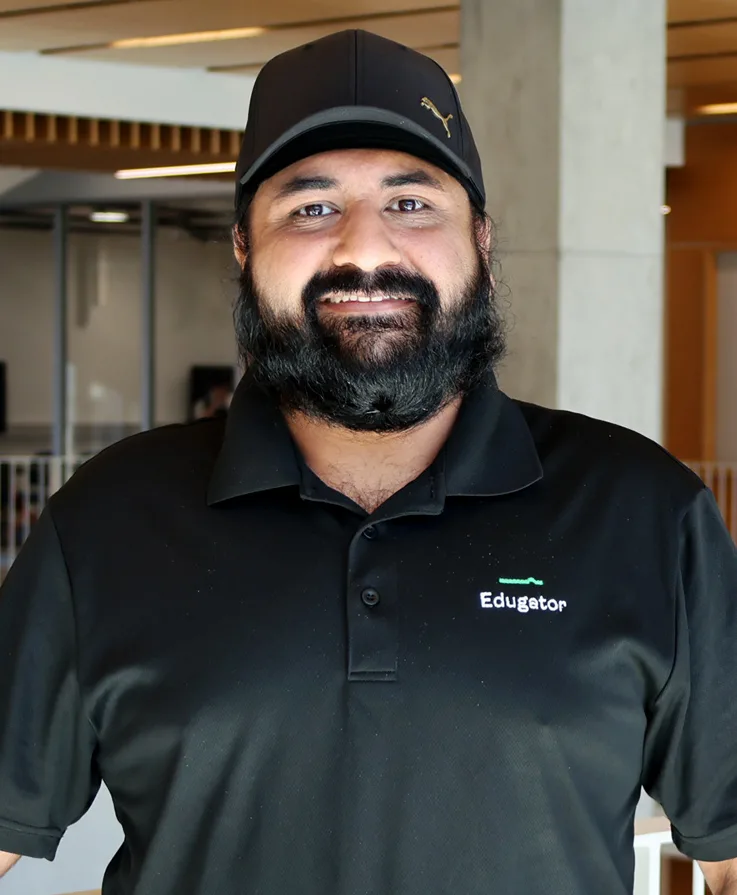
“What set the 10 E3 fellows apart was a clear commitment to teaching-focused careers and a drive to become excellent teachers, not just competent ones,” explained Kapoor. “All 10 fellows serve as visiting instructional assistant professors for the 2026–27 academic year.”
The E3 fellows teach one course in the fall term and two courses in the spring term.
Kapoor leads the training and mentoring components of the program. Since mentoring is a major component of the program, pairings of E3 fellows and faculty mentors began immediately. Each E3 fellow has two to three mentors.
“One mentor is an expert in teaching and pedagogy, and one or two are experts in the fellow’s discipline. The mentors are senior and accomplished. They include associate chairs for undergraduate studies, directors of undergraduate laboratories and peer-learning programs and award-winning teachers,” Kapoor said.
These relationships help fellows navigate challenges both large and small. Mentors offer guidance on everything from designing or delivering a course to academic integrity concerns to managing classroom dynamics and understanding university policies.
“Mentor matches were carefully made based on teaching interests, technical expertise and years of engineering education experience,” Villanueva Alarcón explained.
Every one to two weeks, mentors and fellows meet to discuss classroom experiences, career goals and professional development. Participants also complete a formal teaching development program through UF’s Center for Teaching Excellence and attend monthly E3 workshops designed to strengthen instructional skills and leadership abilities.
The experience culminates with a hands-on educational intervention project presented at UF’s Interface Teaching Conference.
“This has been a transformative experience, not only for the E3 fellows but also for the faculty mentors involved,” Villanueva Alarcón said.
By helping future educators understand hidden curriculum before they step into the classroom, the E3 fellows program is strengthening engineering education and preparing the next generation of faculty to inspire student success from the beginning.
Looking for ways to engage? Find out more on Engineering Education Department Excellence Fund – University of Florida Advancement.